
What Does an AI Implementation Strategist Do?

What Does an AI Implementation Strategist Do?
From a business problem to a system people use.
The short answer
An implementation strategist decides what to build first, connects it to your workflows, and prepares your team to own it. People keep responsibility for the decisions that matter.
Strategy first, tools last
The word people miss in the title is strategist. The technology is the easy part now. Anyone can spin up a chatbot in an afternoon. The hard part, the part that decides whether the whole thing works or dies on the vine, is figuring out what to build, for whom, and in what order.
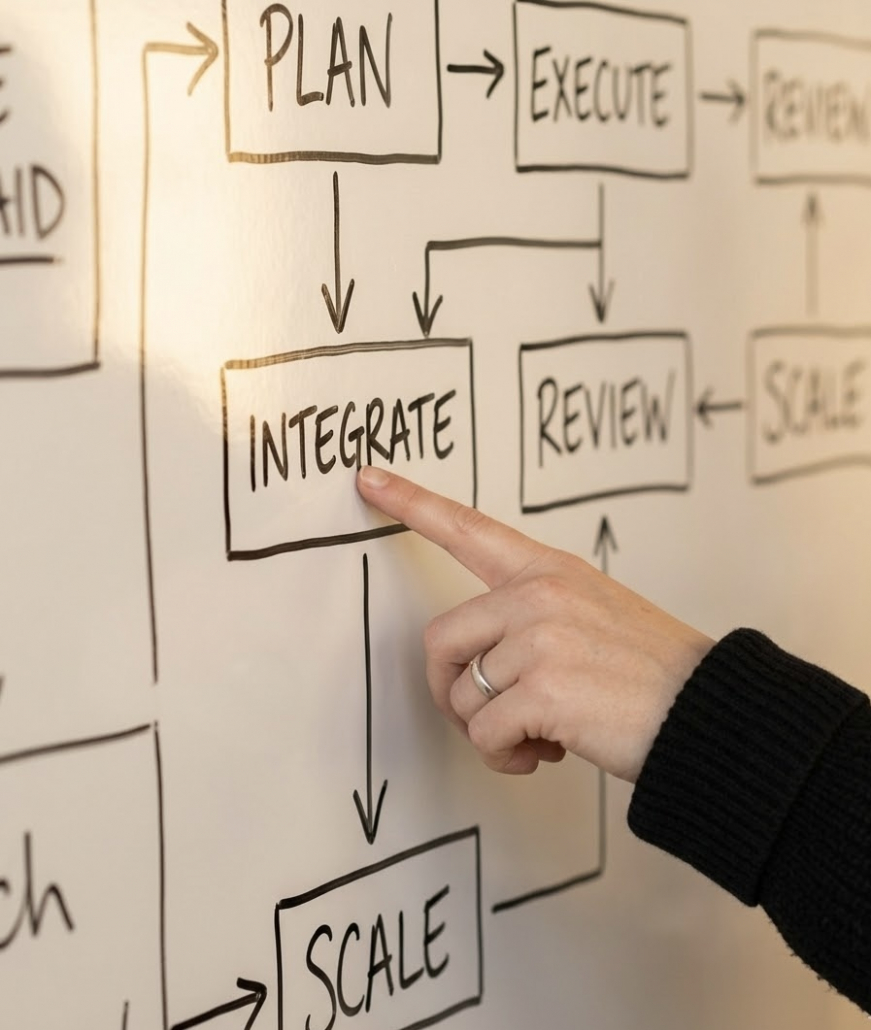
A project can stall when the next step depends on something the team has yet to put in place. A strategist’s first job is to fix the order. That is the whole idea behind the Sequence Model: the highest-leverage move is almost never the flashiest one, it is the one that comes first.
What the job actually involves
Day to day, an AI implementation strategist does five things.
Finds the real problem. They map where your time and money actually go. “We want to use AI” becomes “we lose ten hours a week on the same support questions.” You cannot build the right thing until the problem is that specific.
Sequences the work. They decide what gets built first, second, and not at all. This is the judgment you are really paying for. Getting the order right is what saves you from burning three months on the wrong project.
Connects AI to what you already run. The value shows up when AI plugs into your CRM, your inbox, your accounting, the tools your team lives in. A strategist handles that wiring so the system fits your business instead of asking your business to bend around it.
Keeps a human in the loop. Good implementation does not hand your judgment to a black box. It keeps a person on the decisions that matter and automates the repetitive work around them. I sell human-in-the-loop on purpose, because that is the version that people actually trust and keep using.
Builds for the people who stay. The quiet killer of AI projects is that nobody owns the workflow after the expert leaves, so it dies by week three. A strategist builds the system to be run by your real team and trains someone to own it. That is what the Mission-Driven AI Stack is about: a system your team can run.
How it is different from an AI consultant or a developer
These titles blur together, so here is the honest split. A developer builds what they are told to build. A consultant gives you a recommendation and a deck, then leaves you to execute it. An implementation strategist owns the whole arc: the diagnosis, the order of operations, the build, the handoff, and the part where your team actually adopts it. The strategist is accountable for the outcome. If you want more on how the same skill set shows up across a business, I wrote about how AI gets used in small businesses with real examples.
When you need one
You do not need a strategist to try ChatGPT. You need one when the stakes and the mess get real: when you have a specific expensive problem, when AI has to touch systems you already depend on, when more than one person has to use the result, or when you have tried AI already and it did not stick. That last one is the most common reason people call me. The tools were fine. The order was wrong.
The best way to know what you actually need is a real conversation about your business. That is what a 90-minute working session is for. We look at where your time goes, find the highest-leverage place to start, and you leave with a plan you can act on, whether or not you ever hire me.
A consultant hands you advice. A strategist owns the path from we should use AI to this is running and saving us ten hours a week.
FAQ
What does an AI implementation strategist do?
They decide where AI belongs in your business and make sure it gets built and adopted in the right order. That means finding your real problem, sequencing the work, connecting AI to the tools you already use, keeping a human on the important decisions, and setting your team up to own the system after the engagement ends. The job is measured by whether the system is still in use months later.
What is the difference between an AI consultant and an AI implementation strategist?
A consultant gives you advice and a plan, then hands it back to you to execute. An implementation strategist owns the full path from diagnosis to a working, adopted system, and is accountable for the outcome rather than just the recommendation.
Do I need an AI implementation strategist or a developer?
A developer builds what you specify. A strategist figures out what should be built and in what order, then makes sure it gets adopted. If you already know exactly what to build and just need it made, hire a developer. If you are not sure where AI belongs or your last attempt did not stick, you need the strategy first.
When should a small business hire an AI implementation strategist?
When you have a specific, costly problem, when AI needs to connect to systems you already rely on, when more than one person has to use the result, or when you tried AI and it did not take hold. Those are the moments where getting the order right is worth more than the tool.
Want help finding your first AI win?
Let’s talk about what you need and how we could work together.

Be
Human.